
HOW DO YOU MOVE A CABOOSE?
A Tribute to Those Who Build and Fix Things

How best to move a caboose is not a question I suspect many of you have ever pondered. I have. But before I tell you my caboose story, I owe you an explanation.
As I’ve indicated in prior posts, I’m a person with many hobbies and passions: Alice, cars, baseball, reading, music, my farm in West Virginia, to name a few. And I’m obsessed with American history, especially 20th century history. I’m also an avid collector - of folk art, political memorabilia, trade signs, and more.
(After reading this, Deb suggested I add the following: In case you haven’t figured it out, I have a very understanding wife.)
My interests led me to wanting to fill a barn with old signs, cars and some cool mementos of other 20th century cultural and economic forces. I knew a vintage airplane was out of the question, but a caboose seemed like a good idea. I said “seemed” like a good idea.
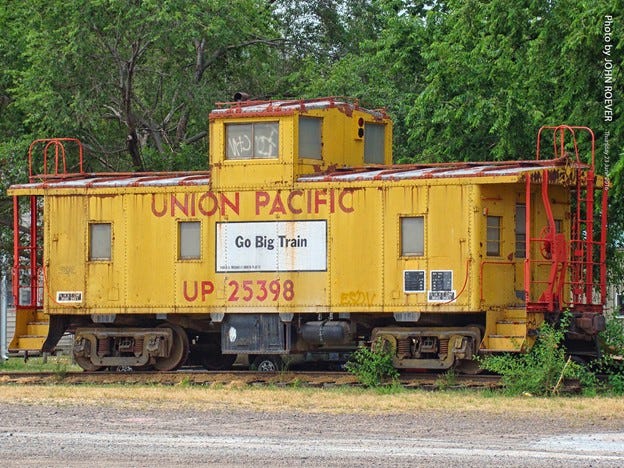
After spending a few weekends driving to old rail yards, and searching online for cabooses, I stumbled onto a used train auction website. I learned there is an entire industry devoted to buying and selling used rail cars. Who knew? I enthusiastically reviewed several cabooses and settled on a 50-year-old Union Pacific caboose that seemed to be in reasonably good shape (as if I would have any idea what constitutes a well-preserved caboose).
After a few back-and-forth offers and counter offers, I was the proud owner of a retired, battered, solid steel caboose.
As I’m sure you’ve figured out, buying a caboose is the easy part of the deal. Moving it is the hard part. Let’s start with a quick quiz:
1. How much does a caboose weigh? I had NO idea.
The answer is 65,000 lbs. That’s about 13 Ford F-150s. So we know Fed Ex is out of the question.
2. How is a caboose moved? Most people would guess a caboose would be hooked to a train and transported by rail. I certainly did. Wrong.
Federal regulations require all operating rail cars to meet stringent safety standards. The only option, therefore, is by flatbed truck. Or to be more precise, 2 flatbeds, as it takes one for the body and another one for the wheels (called trucks). Which explains why a caboose costs pennies per pound.
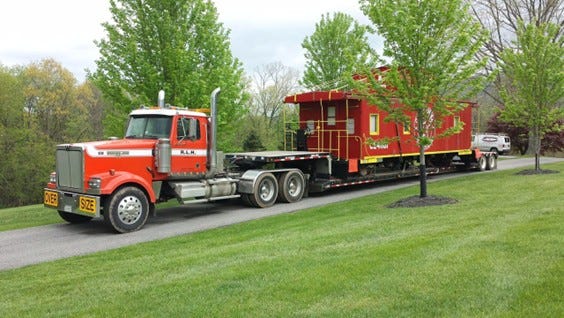
Now I’m getting to the real purpose of this story. The idea of a caboose is fun, different, and admittedly eccentric. But the central figure of this story is not the caboose, it’s the fellow who figured out how to move the caboose.
In the 1960’s, Volkswagen ran a series of brilliant TV spots highlighting the simplicity, diminutive size, low-running costs of a Beetle. One of the VW spots I love opens with a man walking through deep snow. The voiceover poses a question, “Have you ever wondered how the man who drives the snowplow drives to the snowplow?” Then you see a VW Beetle driving through deep snow to a large storage shed. The driver gets out and gets in the snowplow and drives off.
Playing off the VW add, my question is, where does a professional crisis manager go for help when he has a caboose crisis? The answer is the always brilliant, amazingly patient, and endlessly resourceful, Richard.
As everyone in my life knows, for the past 30 years Richard has been the guy I call when I need something - anything - assembled, repaired, built or remodeled. When it comes to appliances on the blink, carpentry work, warning lights in autos, HVAC issues, plumbing problems, problematic remotes, and just about anything else you can imagine, Richard is the guy I call. And his answer is always the same. After I describe my latest problem in vague, non-technical terms, Richard says, “I think I have something in my truck that can fix that.” And he always does. I call it the magic truck.
When I told Richard I needed to move a caboose, he said what he always says, “I can do that.” That he had never moved a caboose before didn’t matter. This time he didn’t have a magic answer in his truck, but he understood the challenge, knew what equipment would be needed and had the network of guys to call for help. In no time, permits were obtained, a crane and trucks showed up, along with a crew of experienced men. Richard even pre-tested the approved route to make sure the caboose would fit under the overpasses and power lines.
Despite Richard’s great work, the caboose move had moments of drama. The truck hauling the main body of the caboose nearly tipped over at the first curve. And there was less than one inch of room to spare at an overpass in Virginia. But Richard delivered the goods, and when he finally got the caboose to my property and secured it, he and his guys celebrated like they had won the Super Bowl. As usual, I added NO value, except to cheer them on.
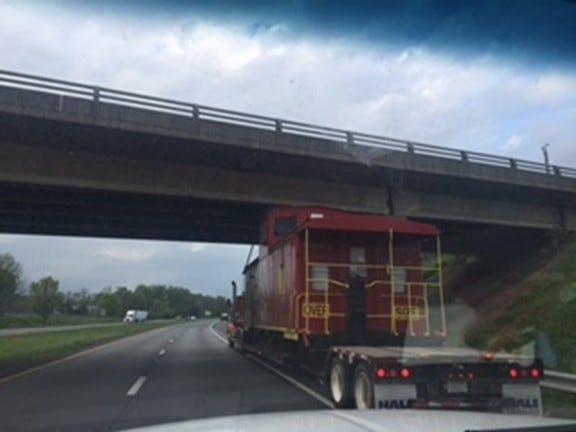
The Scariest Moment of the Move: Maybe an Inch to Spare
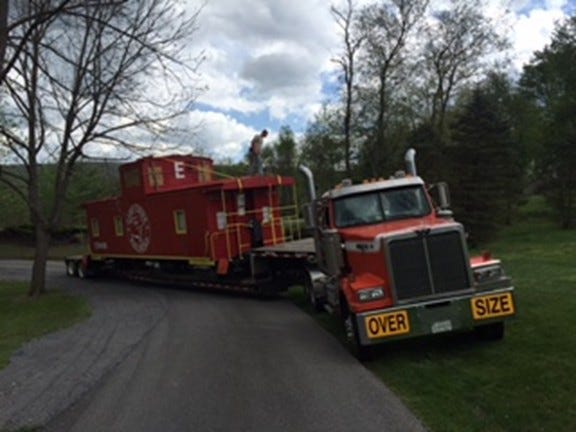
A 65,000 lb Caboose on its Side Would Not be Good
If everyone reading this Substack had to choose between having Richard on speed dial or me, Richard would win easily. He can do real things with his hands. I can’t. He solves important problems that don’t seem all that significant until they occur. And suddenly that problem is the only thing that matters.
Okay, you probably won’t be moving a caboose. But you definitely need every other thing Richard can do. In an AI, digital, white-collar world, we need more - a lot more - people training to be skilled tradesmen and women. More than 40% of construction workers will retire in the next five years. And it’s estimated we are going to have at least two million unfilled skilled trade positions by 2030. This is not a future any of us wants.
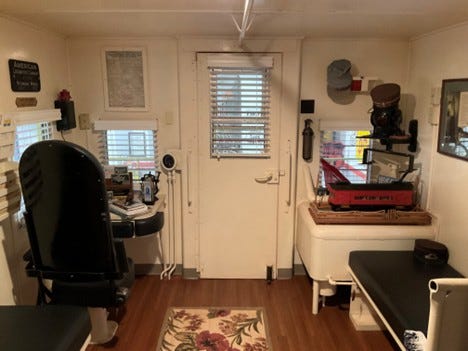
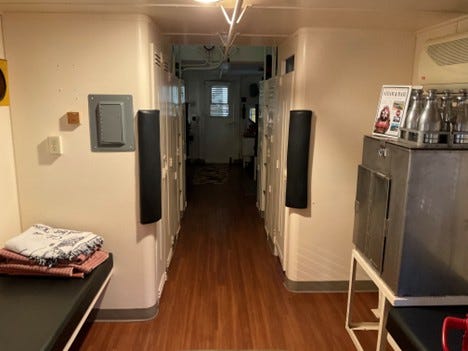
A Caboose Was a Rolling Office With Living Quarters
Richard Brought This One Back to Life
Let me tell you one last story about Richard’s work ethic. A number of years ago he was helping to install a metal roof on my cabin. He was working with a nail gun and happened to bump his elbow as he was twisting to finish a section. The gun fired instantly and the three-inch nail entered his boot through an eyehole and passed completely through his foot and into the plywood roof. In the blink of an eye, he was literally nailed to the roof.
He was shocked, of course, but remained totally calm. He assessed the situation and worked his boot loose from the roof. He grabbed a pair of pliers and slowly pulled the nail back through his foot. (I’m cringing as I write this.) Then he climbed down, got in his truck and drove to the local, small hospital.
At the hospital, the ER Doctor told him he had a serious infection risk and needed to go immediately to the regional medical center in Winchester, VA, 30 miles away. Richard thanked the Doctor for his advice, asked him to pour some more antibiotic solution on his foot and bandage it up. He left the hospital, drove back to my cabin, and finished his work. He never went to the regional hospital and never missed a day of work.
When he told me this story, I told him how amazed I was, but I said there was one detail he left out: Did he bill me for the time he was at the hospital?
Ok, I’m kidding. I love Richard like a brother. And I have endless respect and admiration for everyone who makes a living building, fixing and servicing the things the rest of us depend on to make our lives better. We need them more than ever…but probably not to move a caboose.
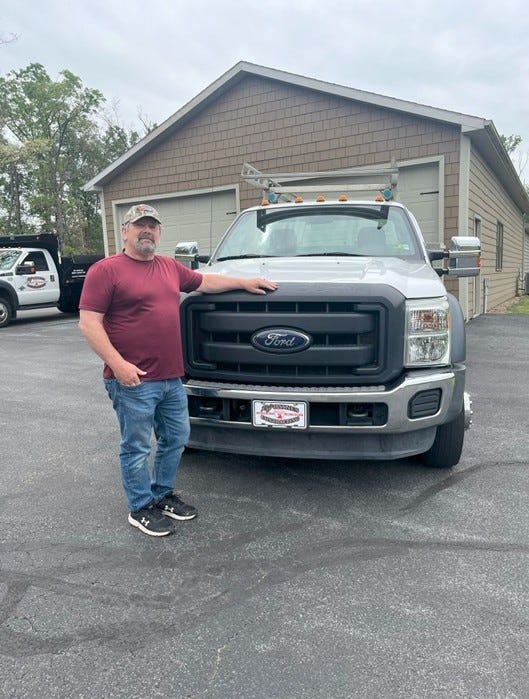
Richard and The Magic Truck
Hope this means you enjoyed it.
Pretty steep!